OCR a Scanned PDF Online
Recognize the text hiding inside a scanned or photographed PDF — in English, French, German, Spanish, Portuguese, Italian, Dutch, Chinese, or Japanese — and make it searchable, selectable, and copyable, free and entirely on your device.
Drop a scanned PDF to run OCR
One PDF at a time. Works best on clear, printed pages — larger or multi-page files take longer to process.
Why run OCR on a PDF with PDFBell
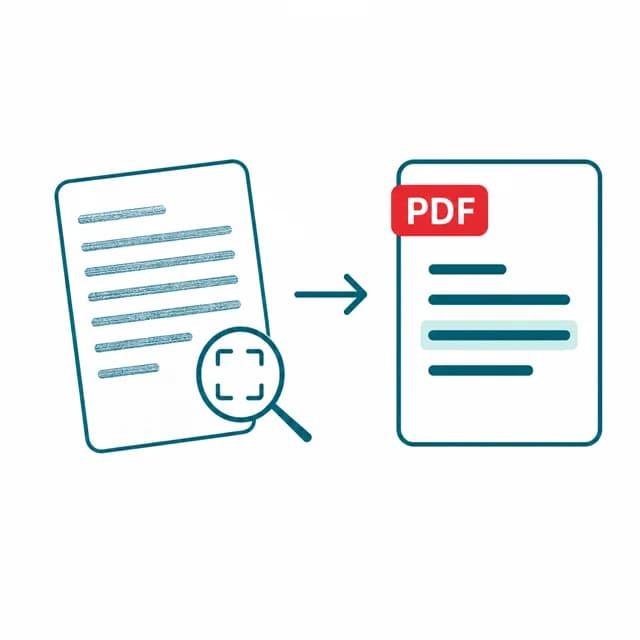
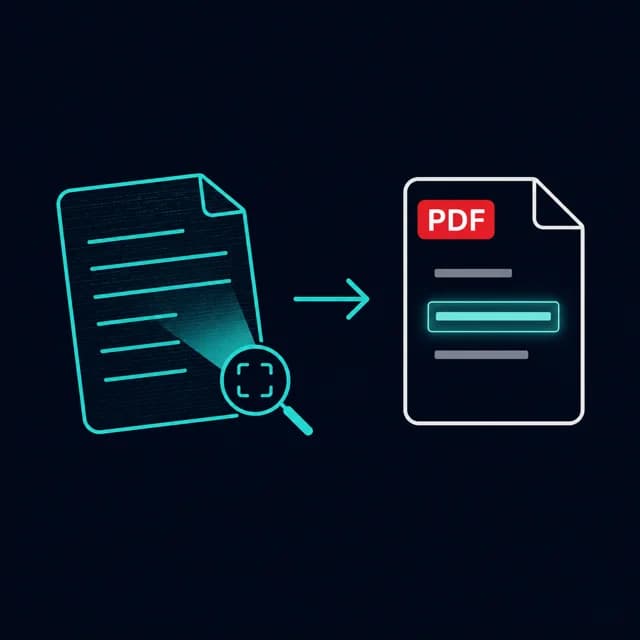
PDFBell's OCR PDF tool reads the text sitting inside a scanned or photographed page — a paper document run through a scanner, a photo of a printed page, or any PDF built from images rather than a real text layer — and recognizes it as actual, selectable text. Pages like this look like a normal PDF but contain nothing a computer can search, copy, or index; OCR (optical character recognition) is what turns the picture of the words back into the words themselves.
Recognition runs entirely inside your browser tab using PaddleOCR, an open-source detection-and-recognition engine compiled to WebAssembly (ONNX Runtime Web) — nothing about the file, or the OCR engine itself, is fetched from or sent to a third-party server. Pick the language printed on the page — English, French, German, Spanish, Portuguese, Italian, Dutch, Chinese (Simplified or Traditional), or Japanese are all supported — and the matching recognition model downloads once and is cached for next time. Each page is rendered at a higher resolution than an on-screen preview, then processed one page at a time, with a progress bar tracking exactly where the run is.
Two outputs are available. The default, a searchable PDF, keeps every page looking exactly like the original scan but adds an invisible text layer underneath it, positioned line by line from the exact quadrilateral PaddleOCR detected for each line of text — including pages that carry their own rotation, so a page you turned 90° or 180° with rotate-pdf still gets an invisible text layer that lines up correctly once a PDF viewer re-applies that rotation. The page still looks like a photograph, but you can now select, search, and copy text from it in any PDF viewer. Turning that option off instead gives you the recognized words as plain text, useful when you just need to pull the content out rather than keep the scanned page's appearance.
OCR works best on clear, well-lit, printed text — a flatbed-scanned page or a clean phone photo of a document typically recognizes accurately. Low-contrast scans, heavy skew, handwriting, and unusual fonts reduce accuracy, the same limitation every OCR engine shares, not something specific to this tool. If a PDF already has a real text layer, pdf-to-text extracts it directly and is faster — this tool is specifically for the pages that don't.
How to OCR a PDF
- Step 1
Add your scanned PDF
Drag and drop a PDF onto the upload area, or click Browse files to choose one from your device.
- Step 2
Choose the OCR language
Pick the language printed on the page from the OCR language dropdown — English is selected by default.
- Step 3
Choose your output
Leave "Create searchable PDF" on to keep the scan's appearance with an invisible text layer, or turn it off for plain text only.
- Step 4
Run OCR
Click Run OCR. Each page is rendered and recognized in your browser, with a progress bar showing which page is currently processing.
- Step 5
Download the result
When the ding! plays, download the searchable PDF or the recognized text, or copy the text straight from the page.
Common ways to use it
Make an old scanned contract searchable
Turn a scanned agreement into a PDF you can Ctrl+F through instead of scrolling page by page looking for a clause.
Recognize text from a phone photo
Run OCR on a PDF built from photographed pages — a whiteboard, a printed handout, a book page — to get usable text out of it.
Archive paper documents properly
Scan and OCR paper records so they're both preserved as images and searchable/indexable going forward.
Pull text out of a scanned receipt or form
Turn the searchable PDF option off to get the recognized words as plain text for pasting into a spreadsheet or note.
Frequently asked questions
Is this OCR PDF tool free?
Yes — running OCR on a PDF is completely free, with no sign-up and no limit on how often you use it.
Is my PDF uploaded anywhere?
No. Both the page rendering and the OCR recognition happen locally in your browser using pdfjs and PaddleOCR — the file you select never leaves your device, and the OCR engine's own files (WebAssembly runtime and recognition models) are served from PDFBell rather than a third-party CDN.
What's the difference between the two output options?
"Create searchable PDF" keeps the original scanned page's appearance and adds an invisible text layer you can select and search. Turning it off gives you the recognized words as plain text only, with no PDF produced.
What languages does this tool recognize?
English, French, German, Spanish, Portuguese, Italian, Dutch, Chinese (Simplified and Traditional), and Japanese. Pick the language printed on your page from the OCR language dropdown before running OCR — its recognition model downloads automatically the first time you use it, then stays cached in your browser.
Why did some words come out wrong?
OCR accuracy depends on scan quality — low resolution, skewed pages, poor lighting, and handwriting all reduce recognition accuracy. Clear, well-lit, printed pages recognize the most reliably.
Does this work on pages that have been rotated?
Yes. If a page carries its own rotation (for example, one turned 90° or 180° with rotate-pdf, or a scanner that saved a landscape page as portrait), the searchable PDF's invisible text layer is positioned to match that rotation, not just the page's raw, unrotated content.